Criteria 2: Awareness
In this article, we shall look at how some of the grocery chains in the US are driving awareness for their mobile app.
Observation 1: Drive End User Awareness of the Mobile App.
Surprisingly, although nearly all the big grocery stores promote online purchases, there is little or no mention of their mobile app. While one can view the calls to action for social media sharing like Facebook, Twitter, Pinterest or Instagram, an user may end up spending a few minutes on the website, looking for the app.
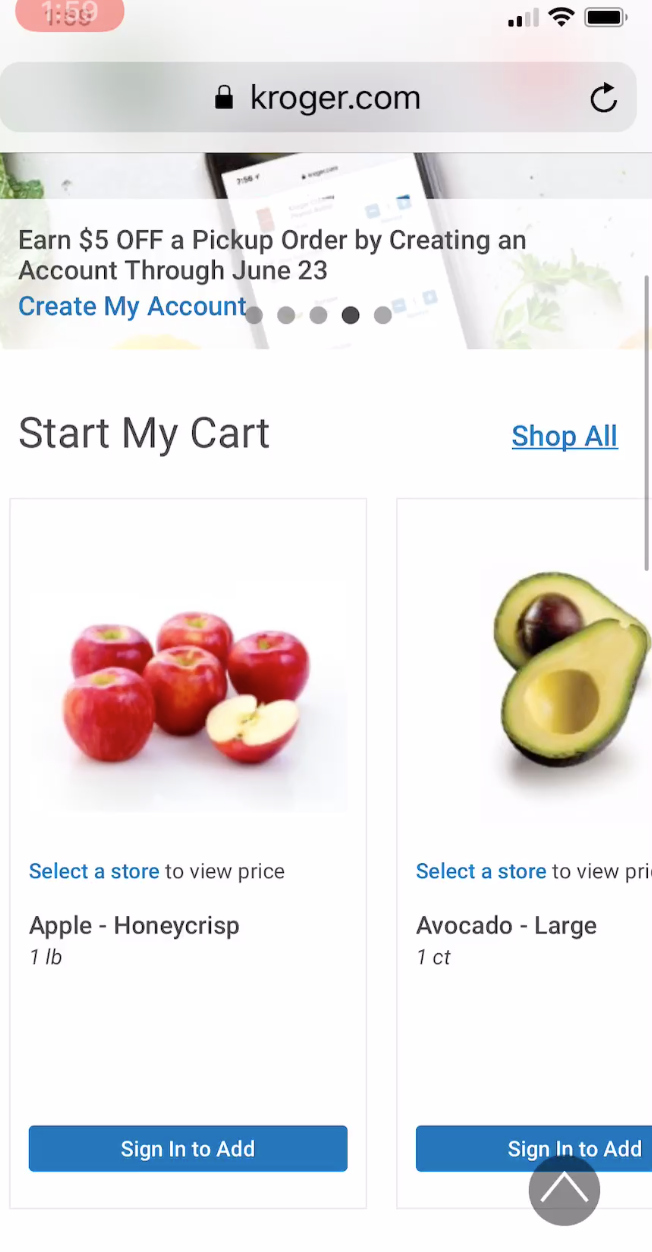
For example, we looked up Kroger’s website. A quick look at Kroger’s homepage shows us an option for online shopping, but you have to scroll down two more pages to find any mention of their mobile app. But if you were to open your browser on your smartphone, it first suggests you download the app.
In comparison, there is no mention of mobile apps anywhere on the website for Whole Food Market.


.
Engaging the mobile customer – how to create awareness?
When considering the mobile shopper, it is important to remember that there may be multiple scenarios of use. For instance, the user may simply choose to download the mobile app and install it. The user may also open a browser and key in the domain. There is yet another scenario where the user may simply make a search on the mobile.
In each case, the user should ideally be directed to the option of installing the app. For Instance, this may be achieved through a pop up window. Given the minimal real estate on the mobile user screen, the placement of this pop-up should be carefully considered.
For example, on initiating a search for “Kroger” from a mobile browser, we observed that there is a small pop-up that directs the user’s attention to the mobile app. However this pop-up does not stay on the top of the screen for more than a few seconds. To see this again, you would have to scroll back up.
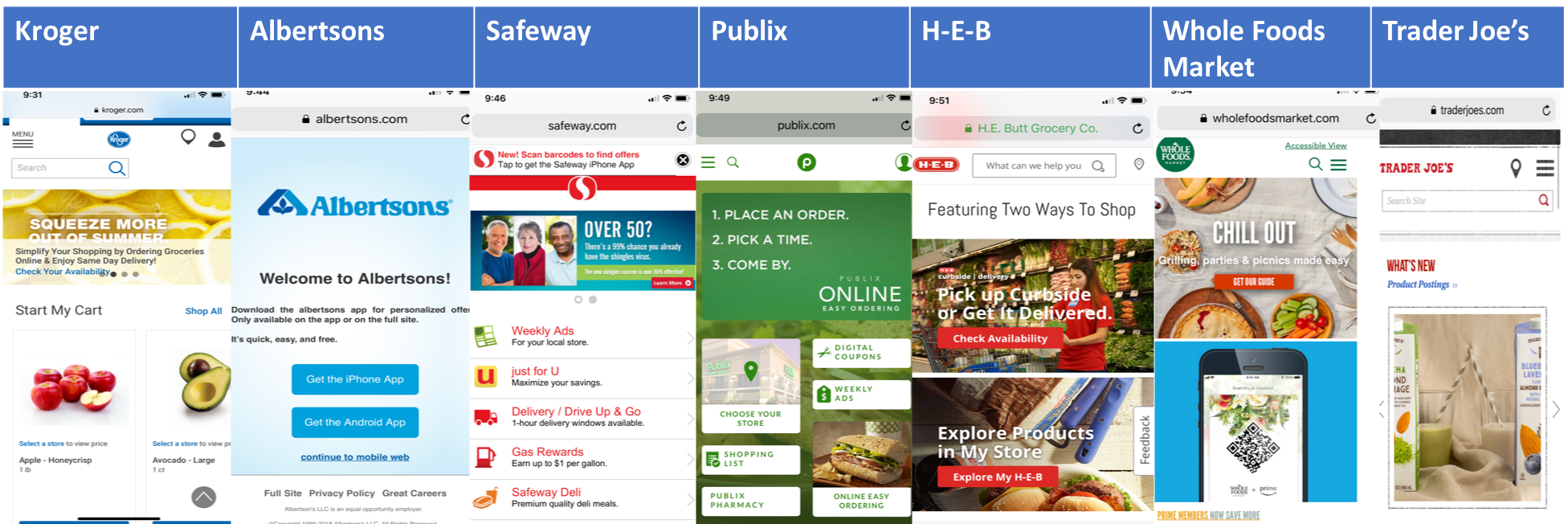
An attempt to reach the websites on a mobile browser for Whole Foods Market, H-E-B, Publix Super Markets resolves into a simple mobile friendly version of the website, without any pop-ups or ads for the mobile app, as shown below. While Whole Foods Market recently updated their mobile version of the website to include a bar code for Amazon Prime, it still does not feature the app.


Search engine results for these stores did not yield immediate results for their mobile apps either.
However, when search query was specifically tagged with the words “Mobile App”, search results for all these stores indicate the presence of mobile apps for both iOS and Android devices, some including phones as well as tablets.
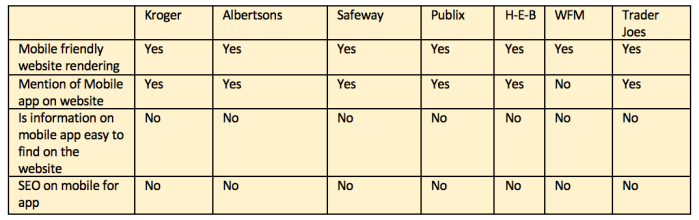
A summary of our initial findings
Stay tuned for our next blog – The Mobile Maturity Model.

 quipbrew